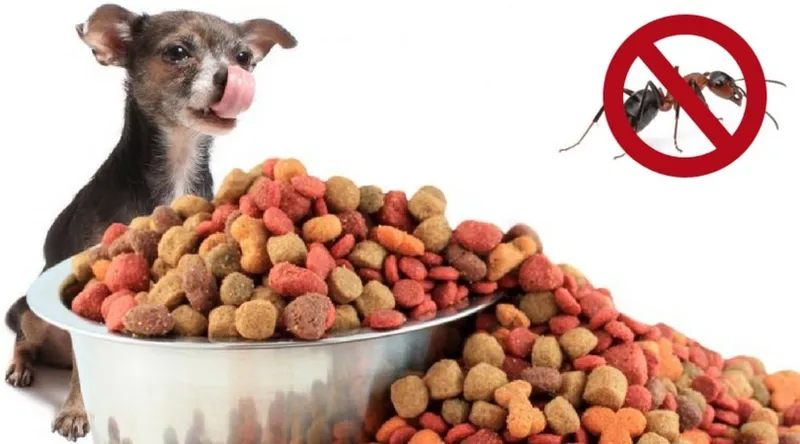
You go to feed your dog and find the bowl crawling with ants. Again.
It’s frustrating, and it wastes food.
The good news is that ants are easy to stop once you know the right approaches. Most solutions are simple and use stuff you already have at home.
This article covers two ways to rescue food that ants have already invaded, using a freezer or cornstarch. Then it walks through prevention, from sealed containers and moat barriers to ant-proof bowls and peppermint oil.
It also explains why some ants, like fire ants, are worth taking seriously.
How To Keep Ants Out Of Dog Food
Before we get into prevention, let’s deal with the immediate problem: ants already in the food.
Never feed your dog ant-infested food, even if it’s the last bag in the house.
Find something else to give him, or use one of the methods below to clean the food first.
Here are the two options for rescuing ant-invaded food.
1. Refrigeration Method
This method has four steps and works well for recovering ant-infested kibble.
You’ll need a strainer, a food dish, and a freezer or fridge.
If you have those, follow the steps below.
Put The Infested Food In a Food Dish
If the food is in a bag or paper, pour it into a dish and cover it tightly so the ants don’t spread inside your freezer.
Put The Food In a Freezer
With the covered dish ready, put it in the freezer and leave it until the food is completely frozen.
There’s no fixed time, it just depends on how quickly your freezer works.
Ants are cold-blooded and can’t survive in extreme cold. They hibernate in cool conditions but die when frozen solid.
Once the food is frozen through, the ants will be dead and easy to separate out.
Pour the Food Into a Strainer
Place a container underneath the strainer, then pour the food in.
Shake it vigorously. The dead ants fall through into the container below.
Keep shaking until nothing else drops out.
Store It
The food is now ant-free and ready to put away.
Store it in an airtight container right away, or the ants will be back.
Clean the surrounding area to remove any food traces that could attract them again, and consider using an ant-proof bowl going forward.
The first pass through the strainer may not catch every dead ant, so repeat the shaking step until you’re satisfied.
2. Corn Starch Method
To get the ants out, you first have to kill them, and cornstarch does exactly that.
You’ll need cornstarch, a large shallow container, and a strainer or colander.
Follow the steps below.
Pour The Infested Food Into a Large Shallow Container
If the food is still in a bag or bowl, pour it into the container.
A wide, shallow container is ideal because it lets the food spread out in a thin layer.
That even spread lets the cornstarch reach all the ants instead of just the ones on top.
Sprinkle the Cornstarch Onto the Infested Dog Food
Once the food is spread out, sprinkle the cornstarch over it.
Cornstarch is safe for animals and humans but deadly to ants, and it works in two ways.
First, ants are attracted to it and eat it, but they can’t digest it and die.
Second, you can sprinkle cornstarch along an ant trail, wait a day or two, then spray it with water. The water and cornstarch combine into a sticky, cement-like mixture that traps and kills ants as it dries.
That second approach works well for clearing ants from your home, not for food you plan to use, since you can’t wet the kibble.
The upside of the trail method is that it can knock out ants at the source, but if you over-spray, the water can wash the cornstarch away before it does its job.
Toss Until Cornstarch Covers the Food Completely
Toss the container until the food is coated white with cornstarch.
Leave it for two to three hours so the ants have time to eat and ingest it.
Once they do, they can’t digest it and die, detaching from the food on their own.
Pour the Food Into a Strainer
Pour the food into a strainer and shake it firmly until the food looks clean.
If ants are still dropping out when you toss it, keep going. Repeat until nothing falls through.
The cornstarch and dead ants fall away together, and any cornstarch that stays on the food won’t harm your dog.
Store the cleaned food in an airtight container right away to prevent re-infestation.
Both methods work, but if you don’t take steps to prevent ants in the first place, you’ll be doing this cleanup over and over.
That’s where prevention comes in.
How To Keep Ants Out Of Dog Food
Prevention is easier than dealing with an infestation after the fact.
You can use just one of these methods or combine several. The more barriers you put in place, the better your odds.
Here’s what works.
1. Store Extra Food Well
Start by making sure extra food is stored in a way ants can’t reach.
There are two good approaches:
Store it in a Sealed Container
Resealable bags or cans with airtight lids both work well.
For extra protection, nest one container inside another. Two layers of packaging make it much harder for ants to detect the food scent.
Ants get in through gaps, so the key is choosing a container with a reliable lid that seals completely.
Create a Moat Barrier
You’ll need two containers (one larger than the other, preferably steel so they don’t rust) and a flat brick or stone.
Glue the brick to the bottom of the smaller container and let it dry for two to three hours.
Once dry, set the smaller container inside the larger one, resting on the brick.
Carefully pour water into the larger container without letting it splash into the smaller one.
That ring of water acts as a moat, and ants can’t cross it to reach the food.
2. Buy Ant-proof Dishes
There are a lot of pet food dishes out there, but ant-proof ones are worth it if ants are a recurring problem.
Some bowls are designed specifically to block ants through physical design alone, like the YUWODA Ant Proof Dog Bowl.
It doesn’t rely on water or chemicals, just the bowl’s structure, and it can double as a regular feeding dish too.
3. Keep the Area Around the Dog Food Clean
Even with food stored properly, ants can still show up if there are crumbs or residue on the floor.
Clean the dog bowl regularly, ideally after every meal.
Wipe down the floor around the bowl too, especially wherever your dog eats. Use a pet-safe soap, and add vinegar or lemon water to the rinse to help deter ants with the scent.
4. Use Other products
A few household products can also help keep ants away from the feeding area.
These include peppermint oil, petroleum jelly, and baby talc powder.
Using Peppermint Oil
Ants locate food by scent, which is why they always seem to find it no matter where you put it.
Peppermint oil disrupts that sense of smell, making it much harder for them to track the food down.
What you need
You’ll need a spray bottle, peppermint oil, a tablespoon, and water.
How to do it
Add a tablespoon of peppermint oil to the bottle, pour in a cup of water, and mix.
Spray or wipe it on the floor around the bowl, including along any ant trails you’ve noticed.
Always dilute it first. In large amounts, peppermint oil is toxic to dogs, so don’t apply it directly on the bowl or anywhere your dog is likely to lick.
5. Use Petroleum Jelly
Petroleum jelly is one of the simpler options for keeping ants away from the bowl.
What You Need
You’ll need petroleum jelly (like Vaseline) and a dog bowl.
It’s not the most foolproof option, since a dog can easily smear it across the floor and make things slippery, or get it on himself, which isn’t ideal either.
How to do it
Apply a ring of Vaseline around the outside of the bowl.
Ants get stuck in it before they can reach the food inside.
6. Using Baby Talc Powder
Baby talc powder works similarly to Vaseline as a barrier, but it also carries a scent that ants dislike.
The downside is that talc can be harmful to pets, so use it carefully and keep it away from the bowl itself.
Now that you know how to remove ants and how to prevent them, there’s one more question worth answering.
Why all the hassle?
Why does it matter so much if a dog eats a few ants?
Because the consequences can be more serious than most people expect.
Ants Spread Bacteria and Diseases-causing Organisms
Most ants don’t carry disease-causing organisms on their own, but they can pick up bacteria and fungi as they travel through garbage cans and bathrooms.
Sugar ants have reportedly transmitted germs found in feces, and Pharaoh ants can carry bacteria like Staphylococcus and Salmonella.
Once those ants get into the food, they contaminate it and make it unsafe for your dog to eat.
Some Ants Can Sting
Fire ants are the biggest concern. Most ants bite and release formic acid, which is irritating but not usually serious.
Fire ants are different. They bite and then sting with their abdomen, releasing an alkaloid venom that can trigger allergic reactions in dogs.
If your dog eats fire ant-infested food, he could get sick quickly. Call pest control as soon as you spot fire ants in or near your home.
How Can You Tell?
Fire ants are small and reddish-brown. They don’t prefer to live close to people, but they build mound nests in yards near homes to make foraging easier.
Not every reddish-brown ant with a mound is a fire ant, so if you’re unsure, get a pest control expert to take a look.
Signs of fire ant bites include pain, itching, and sores.
The Issue of Cost
You can salvage most ant-infested dry food with the methods above, but some infestations are bad enough that throwing the food away is the only real option.
Replacing food regularly adds up, which is another reason it pays to prevent the problem in the first place.
The cleanup steps aren’t difficult if you follow them, and once prevention habits are in place, things stay manageable.
Focus on removing food traces after every meal through regular cleaning, and lean on pet-safe soaps or lemon water to keep ants from coming back.
Final Thoughts
Ants in your dog’s food bowl are more than an annoyance, as certain species like fire ants can sting and some carry bacteria that contaminate what your dog eats. Getting the problem under control starts with understanding why ants show up in the first place.
Storage and cleanliness are your two most reliable tools. An airtight container keeps the scent locked away from foraging ants, and cleaning the bowl and floor after every meal removes the traces that draw them back.
When those basics alone aren’t enough, methods like a water moat barrier or an ant-proof bowl offer a physical solution that doesn’t involve chemicals near your dog’s food. Peppermint oil and petroleum jelly can work in a pinch, but use them carefully since both carry risks if your dog comes into direct contact with them.
The goal is to stay ahead of the problem rather than repeatedly rescuing ant-invaded food. A little prevention each day keeps mealtime clean and safe for your dog.
Frequently Asked Questions
The most reliable barrier is water. Set the food bowl inside a shallow dish or moat bowl with water in the gap, since ants can't cross it. A ring of food-grade diatomaceous earth around the feeding area works too, and a smear of petroleum jelly under the bowl's base stops climbers.
Ants avoid vinegar, peppermint, cinnamon, and citrus, which is why these show up in so many home remedies. Around a dog, plain white vinegar is the safest pick for wiping floors and trails. Be careful with essential oils, since many of them, including peppermint and tea tree, are toxic to dogs if licked.
Yes, toss food that's actively crawling with ants and wash the bowl in hot soapy water. A few ants won't poison your dog if swallowed, but an infested bowl or bag is contaminated and will keep drawing the colony back. Move the remaining kibble into a sealed, airtight container.
Kibble is rich in fats and proteins, and a bowl that sits out all day is a free buffet. Scout ants find the crumbs, then lay a pheromone trail for the rest of the colony. Scheduled meals, prompt bowl pickup, and a quick floor wipe break that cycle.
Outdoor feeding is the hardest case, so use a moat-style bowl and remove it as soon as the meal ends. Rinse the spot afterward to erase the scent trail. If you can, shift feeding indoors during the warm months when ant traffic peaks.